Researched October 2026 — prices from retailer pages; not yet hands-on tested by the Hub
White canes — every style, type & model
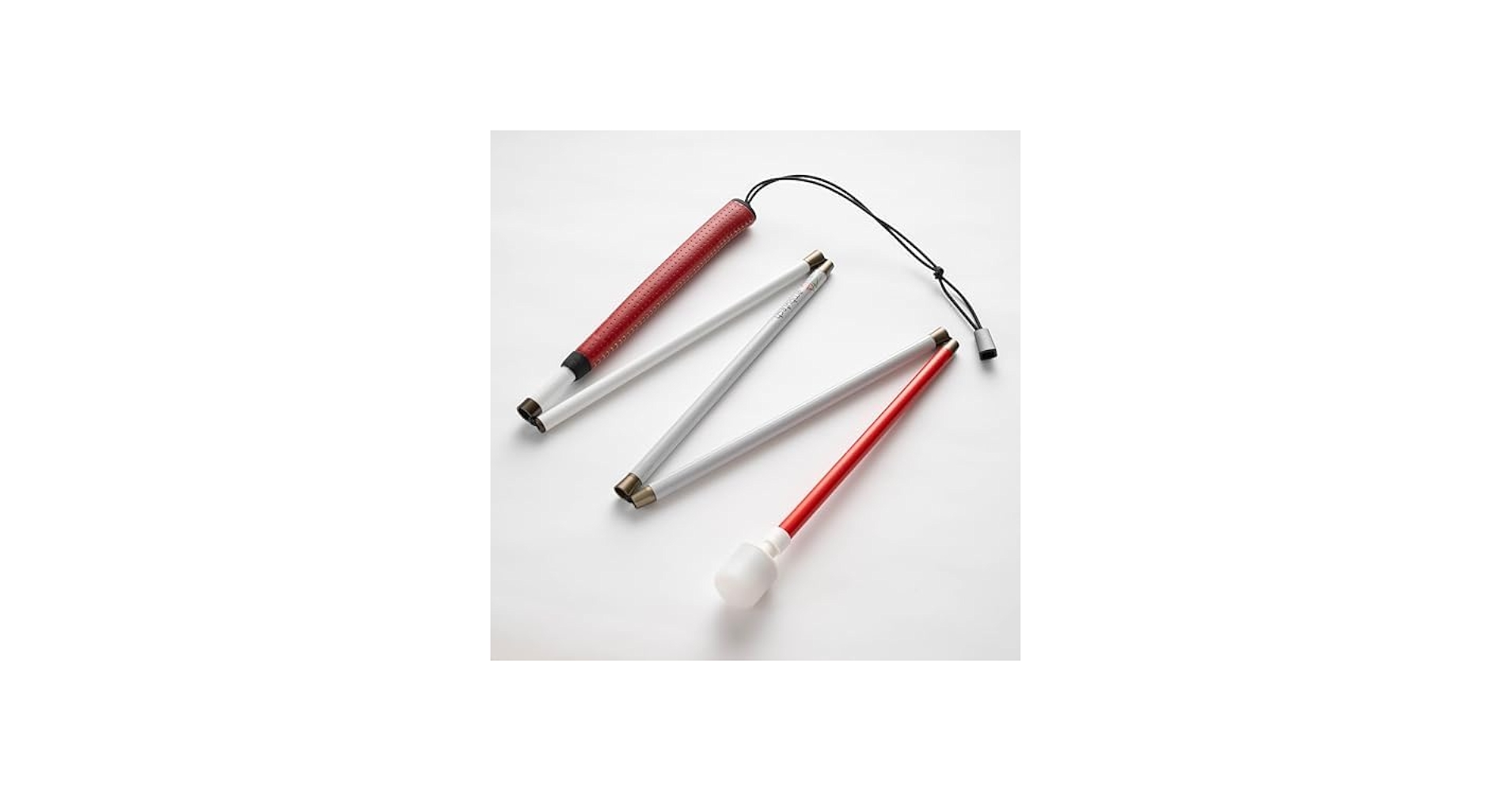
The verdict: There is no single “white cane.” There are folding canes and rigid canes, aluminum and graphite and titanium, ID canes that weigh almost nothing, kids’ canes, canes built for hiking trails — and the right one is the one that matches your body, your technique, and your day. This page lists the real lineup by type, with the price each retailer actually showed in October 2026. Where a price could not be confirmed, it says UNCONFIRMED — we flag it rather than guess, and dated prices are labeled dated.
Start free, whatever you choose. The National Federation of the Blind gives a free rigid fiberglass cane to any blind person in the United States, and will replace it every six months. Claim that first — it costs nothing, and the length you learn from it follows you to every cane after. The first link in the buy box below is that program, on purpose.
Spotlight: the Ambutech NO-JAB — the cane that doesn’t punch back
Every cane user knows the jab: the tip catches a crack, the handle slams into your wrist or stomach. The Ambutech No-Jab Mobility Cane — Premium Leather Handle (JGL4090), $75.01 at ambutech.com, is built around that moment. Its patented shock-absorbing top section compresses about five inches on impact, soaking up the hit before it reaches you; the grip is perforated sheepskin leather, and the shaft is graphite. It takes hook-style tips only, in lengths from 40 to 64 inches. It is the premium pick in the folding lineup below — and if jabs are the thing you hate most about your current cane, it is the first model to look at.
Folding canes — aluminum
The workhorses. Four to six sections on an elastic cord: shake the cane out and it snaps together; pull the sections apart and it folds into a bag or booth seat. Aluminum is the heaviest of the three shaft materials and the cheapest — and for many daily travelers, entirely enough cane.
Folding canes — graphite, fiberglass & composite
Graphite is about 20% lighter than aluminum with better flex and better tactile transmission — more of the ground reaches your hand. Fiberglass sits between: lively feedback at a budget price. These are the folders most experienced travelers upgrade to.
Rigid canes — one piece, nothing to break
A rigid cane is a single shaft: no joints, no cord, nothing between the tip and your hand. Travelers who prize ground information often end up here. The cost is logistics — a five-foot cane doesn’t fold, so it leans in corners and needs a plan in every car and restaurant.
Telescoping canes — the slimmest carry
Telescoping canes slide down into themselves and end up shorter and slimmer than any folder — the spare-in-a-drawer, cane-in-a-purse build. The trade-offs: a thinner shaft carries less ground detail, and the lock holding it extended must be seated firmly, every time.
ID & support canes — being seen, and being steadied
An ID (identification) cane is not a mobility tool — it’s a signal. It tells drivers, staff, and strangers that you can’t see well, and it’s what many low-vision people carry when they need little or no ground feedback. A support cane is the opposite job: it bears weight. Ambutech makes white support canes so a person can have the support and the visibility in one cane.
Children’s canes & all-terrain canes
Kids’ canes are sized-down real canes — shorter lengths, smaller grips — because a child learning travel deserves a tool that fits, not a cut-down adult cane. All-terrain canes go the other direction: titanium, flip locks, and grips you can choke up on, built for trails, beaches, and snow.
A note on customizing a child’s cane: Ambutech sells 6″ replacement golf grips in black, green, orange, blue, and pink (from $1.81) sized for its folding and rigid kiddie canes — a small thing that makes the cane feel like theirs.
Handles & grips — the part your hand lives on
The grip is the one part of a cane you touch every second, and makers offer more variety than most listings admit. Straight handle with a flat-sided grip is Ambutech’s standard across its aluminum, graphite, and rigid lines — the default O&M grip, and the flat side tells your hand which way the cane is oriented. Golf and putter grips — firm rubber, shaped like a golf club’s — come standard on Revolution canes and as Ambutech’s ribbed putter handle; the DMI folder uses a putter-style vinyl grip. Cork and wood grips appear in the Ambutech lineup as warmer-feeling options. The NO-JAB’s sheepskin leather grip is the premium end: 10.5 inches of perforated leather with ventilation holes. The AwareWolf ATC’s 16-inch EVA foam grip is the outlier — long enough to change hand position on hills, like a ski pole. Ambutech’s support canes offer a derby-style Classic handle or a Modern handle. One honest gap: no major white mobility cane with a palm grip was found in 2026 — palm grips exist on support and fashion canes, not on O&M canes. And nearly every cane above ships with a wrist loop or strap; if yours doesn’t, it’s the first accessory to add.
Smart canes — a supplement, not a substitute
WeWALK Smart Cane V2 pairs an ultrasonic smart handle — overhead obstacle detection, turn-by-turn navigation through its app, a built-in speaker — with an Ambutech graphite shaft: $850 at LS&S (verified live Oct 2026), while MaxiAids lists a 54″ version at $599.95, so retailer spread is wide. The WeWALK Smart Cane V2 Plus with AI adds a voice assistant with four years of AI service included, at $1,250 (LS&S, verified live). Both are folding mobility canes underneath the electronics — the smarts supplement cane skills; they don’t replace them, and no smart cane detects drop-offs the way a tip on the ground does.
What blind reviewers say — and they do not agree. Community perspective, paraphrased from the reviewers’ own coverage: Sam Seavey of The Blind Life (88,000 subscribers) calls the Smart Cane 2 a next-generation leap — about 40% lighter than the first model, with stronger obstacle detection, a louder Harman Kardon speaker, physical buttons, a built-in flashlight, USB-C charging, and ChatGPT integration — and recommends it for profoundly blind full-time cane users. Blind creator Josh Tseng’s viral verdict runs the other way: his review asks whether the sensor technology actually helps in daily travel or is mostly hype at a $600-class price. The Double Tap podcast lands between: useful for transport and travel, but a smart cane only matters if it fits your real habits — and a plain cane’s simplicity still wins for many travelers. All three are printed here because that disagreement is the review: the technology is real, and whether it earns its price depends on how you travel.
One more from the community shelf: light-up canes. Sam Seavey has covered the Blind Jedi light-up cane — a DIY lighted-cane project from blindjedi.com — and the Gizahand LED mobility cane appears in his White Cane Guide. The idea is visibility in the other direction: the cane announces you to drivers at night. Know the counterpoint from the same community coverage: Sam flags that colored custom canes may conflict with white-cane laws in some states and reduce how instantly drivers recognize the cane — check your state before a cane becomes a color.
Length matters more than material. The common fitting rule is a cane that reaches roughly your sternum (breastbone) when you stand straight with the tip on the ground — longer gives more warning and suits faster walking; shorter suits crowded indoor spaces. Two travelers the same height can honestly need different lengths. If a state agency or an orientation-and-mobility instructor will fit you, take the fitting: it’s free expertise, and the number follows you to every cane after.
The blind-specific details
| Works without sight | It is the original no-sight tool. The differences that matter are all in the hand: weight, flex, and how much of the ground arrives through the shaft. |
|---|---|
| Setup without sighted help | None for any build. A folding cane assembles itself by its cord; a rigid cane is a cane; a telescoping cane pulls out and locks. |
| Grips | Flat-sided straight grips, golf and putter grips, cork, wood, sheepskin leather, and long foam grips all exist — see the handles section above. Grip shape is personal and matters over miles; it is the one part worth handling before you commit, if a local chapter or agency keeps demo canes. |
| Watch out for | Folding cane elastic wears out — learn whether your model’s cord is user-replaceable before it fails on a trip. Telescoping locks need a firm seat every time. Prices vary sharply by retailer on a few models (the Lumex and the WeWALK especially) — compare. And every cane choice is also a tip choice: the tip does the actual reading, covered on its own page. |
- The range
- Free (NFB) to $1,250 (WeWALK Plus). The mainstream daily-driver band is $28–$55; the NO-JAB is $75.01; all-terrain tops out at $120.
- Materials
- Aluminum (heaviest, cheapest), fiberglass (lively, budget), graphite/carbon fiber (lightest, best feedback), titanium (all-terrain and premium telescoping).
- Rating
- Specialty products sold mainly through blind-aid stores — no Amazon star ratings captured in our research, and none invented here.
- Unconfirmed prices
- Flagged UNCONFIRMED in the tables above: Ambutech HiLites, fiberglass folder with pencil tip, rigid with jumbo roller, Slimline telescoping graphite, Aisenth, Ambutech ID folding cane (dated figure only), Ambutech support canes, VISIONU children’s cane. NFB carbon-fiber prices are labeled dated where they appear.
- Before you pay
- The National Federation of the Blind gives a free white cane to blind people in the United States — see the buy box below. Claim the free one first; spend money later, on the upgrade you actually want.
Ready to buy?
You’ve read the blind-specific part first — that’s the point of this page. The sellers are the exit:
target="_blank" rel="noopener", affiliate link
target="_blank" rel="noopener", affiliate link
target="_blank" rel="noopener", affiliate link
target="_blank" rel="noopener", affiliate link
target="_blank" rel="noopener", affiliate link
target="_blank" rel="noopener", affiliate link
target="_blank" rel="noopener", affiliate link
Then read the cane tips page — the tips nobody told you about, taught properly (opens in a new tab)
Blind-owner reviews
No reviews yet — write the first one. Every review is read by a human before it appears.